 Curve fi
 liquidity pools: Your first deposit
Curve fi liquidity pools accept supported tokens in exchange for liquidity provider (LP) tokens representing a share of the pool’s assets. For your first deposit, choose an existing pool on the network holding your tokens. Review its assets, deposit amounts, expected LP output, and transaction costs before granting any required spending permission. You can deposit without staking, or combine those actions where the pool supports it. Completion means that the transaction succeeded and the resulting pool share belongs to the intended account. A quoted yield doesn’t establish either fact. Keep the deposit preview unsigned if the asset exposure or minimum output isn’t acceptable.
Choose the pool before committing your tokens
Start with the pool’s assets and network, then examine the deposit options that accept your available balance. The token contracts must match the assets that the selected deposit method accepts. Keep enough of the network’s gas token available for the required transactions. An asset balance alone doesn’t establish that the wallet can pay those costs.
Pool selection also determines the exposure that begins after deposit. StableSwap targets assets with closely related prices, while CryptoSwap handles assets whose relative prices fluctuate. A stable relationship can break. Trading during a depeg can concentrate a pool in the weakening asset, so a deposit made with one token can expose you to losses involving another.
You can stop at the unsigned preview. Once a deposit executes, reversing the position requires a withdrawal under the pool’s then-existing conditions.
The pool share that replaces your deposit
LP tokens represent a share of the assets in a particular liquidity pool. Their quantity uses a different unit from the tokens deposited. Pool balances, asset rates, and the deposit calculation determine the amount minted. Trading fees accrue through the pool position, while market movements can reduce its value. A gauge is a separate contract that accepts LP tokens for eligible incentives.
Must you deposit every token in the pool?
Many existing Curve pools accept a deposit of a single constituent token, so owning every pool asset isn’t a universal requirement. Where supported, you can also supply several assets in chosen proportions. The available choice depends on the particular pool and deposit contract. Your first personal deposit into an established pool differs from the initial deposit that creates its liquidity.
A deposit that follows the existing proportions and a deposit concentrated in one asset can produce different terms. Changing the pool’s balance affects the mint calculation and applicable fees. Compare the expected LP output for the actual amounts entered. Don’t assume that an equal token count means equal value, or that a single-asset deposit preserves exposure only to that asset.
How much output should the deposit accept?
The deposit’s minimum LP output should express the lowest pool-share quantity you’re willing to receive under the quoted terms. Expected output is an estimate; minimum output is an execution constraint. A slippage tolerance connects those values by allowing a specified reduction from the estimate. A larger tolerance permits a worse outcome.
A StableSwap-NG deposit reverts if the calculated LP mint amount falls below its specified minimum. Pool activity can change the calculation between preview and execution. Refresh an old quote before signing, especially after waiting for an approval transaction. Lowering the minimum simply to clear an error changes what the transaction may accept.
Network charges are separate from adjustments inside the pool’s deposit calculation. Approval, deposit, and any separate staking transaction each require their own execution resources. Use the wallet’s estimate for the operation being signed. A pool’s advertised trading fee doesn’t describe the total cost of establishing your position.
A first deposit with or without immediate staking
Consider a hypothetical first deposit into an existing pool that supports both ordinary deposits and combined deposit-and-stake transactions. The selected assets, amounts, quote, and transaction timing are hypothetical inputs. Both choices start with the same supported token balance and sufficient gas. Required spending permissions must cover the selected method.
For an ordinary deposit, the transaction adds the selected assets and mints LP tokens to the intended recipient. After successful execution, inspect the transaction’s token movements and that recipient’s LP balance. An increase attributable to the deposit establishes the new pool share.
For the combined action, the transaction also places the LP tokens into the pool’s gauge. Inspect the same deposited amounts and minted share, then reconcile that share with the account’s gauge stake. A wallet LP balance alone won’t describe this completed position.
Timing affects both choices because the pool can change while approval or signing remains pending. Refresh the quote before submission and retain an acceptable minimum output. If the updated terms are unsuitable, leave the deposit unsigned. An already confirmed approval remains a separate permission.
Both successful choices establish liquidity ownership, but the share ends in different locations. The transaction record and corresponding balance establish completion independently of any advertised reward rate. Staking adds eligibility for available incentives; it doesn’t prove future earnings.
Metapools and zaps change the deposit path
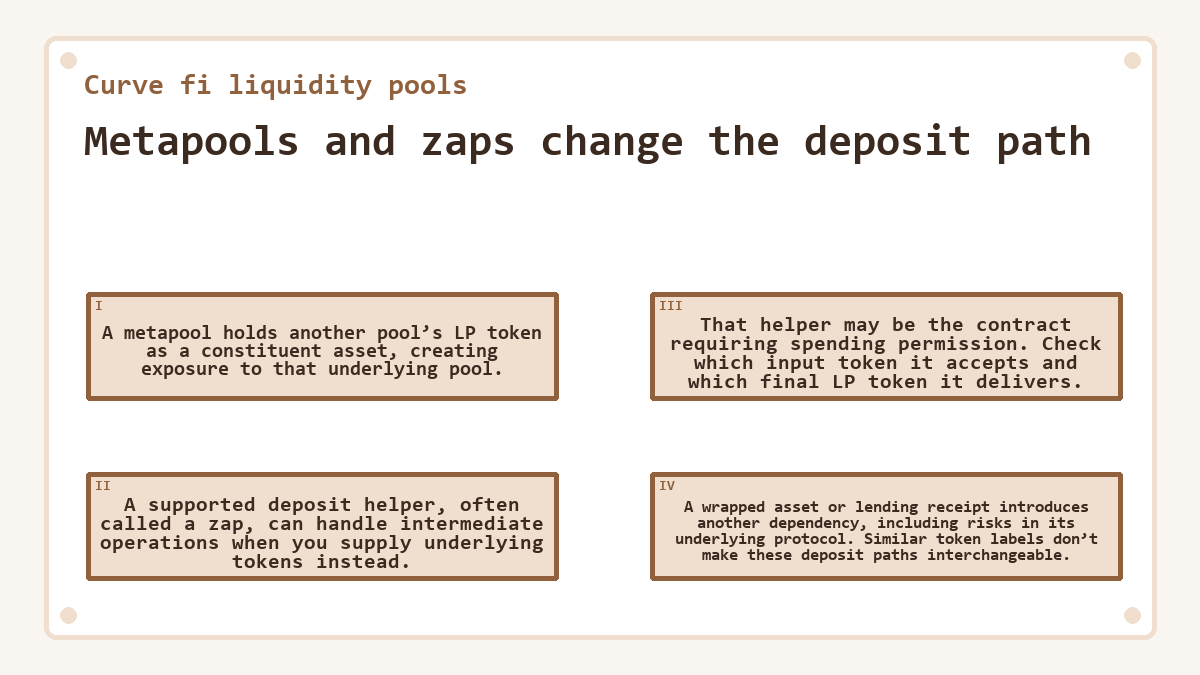
A metapool holds another pool’s LP token as a constituent asset, creating exposure to that underlying pool. A supported deposit helper, often called a zap, can handle intermediate operations when you supply underlying tokens instead. That helper may be the contract requiring spending permission. Check which input token it accepts and which final LP token it delivers. A wrapped asset or lending receipt introduces another dependency, including risks in its underlying protocol. Similar token labels don’t make these deposit paths interchangeable.
Know the withdrawal terms before the first deposit
A proportional liquidity withdrawal returns assets according to the pool’s balances at withdrawal. Those proportions can differ from your original deposit. Where available, a single-asset withdrawal concentrates the output into one chosen token and has its own quote and constraints. Depositing one asset therefore doesn’t secure a later return of that same quantity.
Staked LP tokens generally need to leave the gauge before redemption from the pool. Underlying lending assets or nested pools can add further dependencies. Understand the supported exit method while choosing the deposit method, rather than assuming every position has identical withdrawal behavior. Fees earned during the holding period may not offset asset losses, and successful deposit execution doesn’t protect funds against a later contract exploit.
Curve fi liquidity pools FAQs
Can sending tokens directly to a pool address create my first deposit?
A plain token transfer to a pool address doesn’t execute the liquidity-deposit function or establish an LP share. Use the supported deposit operation, which performs the required accounting and minting. Tokens arriving at a contract address aren’t, by themselves, evidence that the sender received a redeemable position.
Is joining an empty pool different from making my first personal deposit?
Yes, initializing an empty pool can require assets that an established pool lets you omit. In StableSwap-NG plain pools, the initial deposit requires every constituent coin. That condition concerns the pool’s first liquidity, not each wallet’s first contribution. Other implementations have their own initialization requirements.
Why might the LP token quantity be smaller than my deposited token quantity?
LP tokens and deposited tokens represent different units, so a smaller numerical LP balance doesn’t establish a loss. The mint calculation converts your contribution into pool shares and accounts for the relevant pool conditions. Compare the received LP amount with the deposit quote, then assess the assets represented by those shares.
Will my first liquidity deposit be publicly visible?
The deposit transaction and associated onchain token movements are publicly inspectable. Observers can connect the sending address with the resulting pool position or gauge activity. A wallet address doesn’t necessarily identify its owner, but using the interface doesn’t make the deposit private or conceal its transaction history.